
What if your wallet could show you exactly what a transaction will do before you ever hit “confirm”? That question frames the practical value proposition behind Rabby’s browser extension and its signature feature: transaction simulation. For DeFi power users—traders, liquidity providers, smart-contract-interacting devs—simulation promises a different mental model for security. Instead of treating the extension as a blunt signing tool, you treat it as an execution sandbox that renders state changes, costs, and approval risks visible in human terms.
This article examines how Rabby’s Chrome/Chromium extension implements that sandbox, why the mechanism matters for U.S.-based DeFi users dealing with multi-chain complexity, where the approach succeeds, and where it still leaves gaps. I’ll use a concrete, realistic case to highlight trade-offs and then translate the implications into practical heuristics you can reuse.
Case: swapping an obscure token on Arbitrum while your main ETH balance sits on Ethereum
Imagine you visit a new DEX on Arbitrum to take advantage of a short-lived arbitrage. Your primary account is funded on Ethereum L1 and shows ample ETH in MetaMask, but the Arbitrum chain requires bridged ETH for gas. Normally you’d: (a) manually switch networks, (b) bridge tokens or top up gas on Arbitrum, (c) approve the token contract, and (d) execute the swap—each step exposing you to user error or malicious contracts that abuse token approvals or trick you into signing a transaction with hidden side effects.
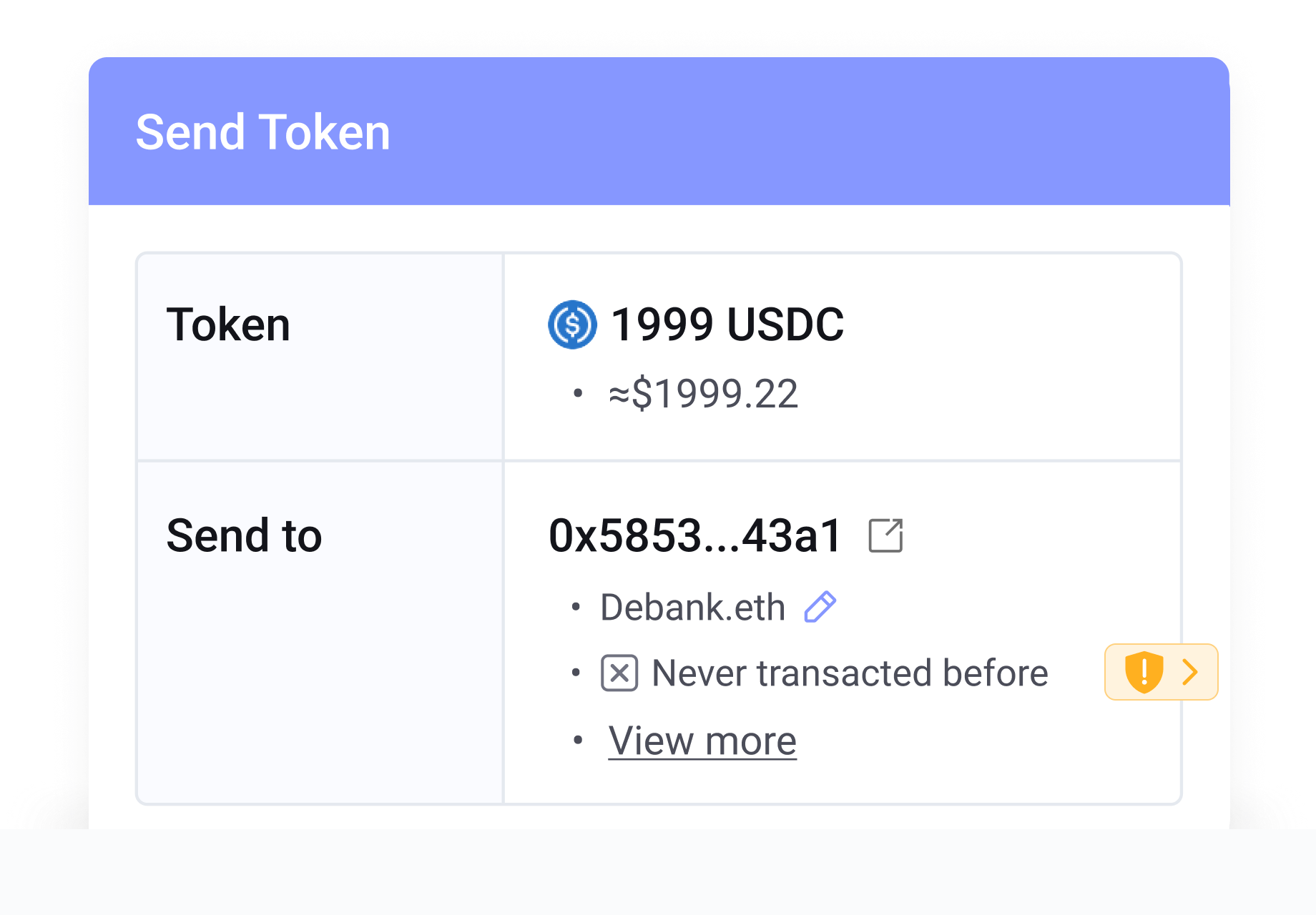
Rabby compresses and mediates that workflow in two concrete ways. First, automatic network switching detects the Arbitrum dApp and flips your active network—so you’re not accidentally signing transactions intended for a different chain. Second, the cross-chain gas top-up feature lets you send a gas token to Arbitrum from another chain without going through a separate bridging UX. Most important to this case: before finalizing a swap or approval, Rabby runs a transaction simulation that displays exact token balance deltas and the estimated fee in the native gas token. That changes the cognitive workload from trusting a text description to reading an expected state change.
How transaction simulation works (mechanism, not marketing)
At a mechanism level, simulation means the wallet takes the prepared transaction—target address, calldata, value—and executes it on a local copy of the target chain’s state (or queries a node that supports eth_call semantics) in read-only mode. The result is a deterministic trace: which balances change, which calls revert, how much gas the EVM estimates will be consumed. Rabby then formats those outputs as user-facing numbers: “you will lose 1,234 token X, gain 0.456 token Y, estimated fee 0.0032 ETH.”
That design reduces a class of risk known as blind signing, where a user signs an opaque payload because the UI shows only the surface intent. Instead of simply seeing “approve 1,000,000 TOKEN,” you see the estimated balance delta (and if the approval would grant unlimited allowance). Combined with Rabby’s pre-transaction risk scanning—flagging previously exploited contracts, suspicious patterns in calldata, or non-existent recipient addresses—the simulation becomes a second line of defense: both behavioral (users can decline odd deltas) and technical (the engine may detect revert patterns or suspicious gas usage).
Where the simulation materially improves safety—and where it doesn’t
Strengths:
– Visibility into balance changes. For complex composable transactions (meta-transactions, aggregator trades, permit flows) the biggest user error is misreading what the final token exposure looks like. Simulation renders that visible.
– Cheap sandboxing. Running eth_call-style simulations is fast and does not incur on-chain costs; it’s a real-time feedback loop compatible with browser extensions.
– Pairing with approval revocation. Seeing future balance moves makes it easier to reason about whether an approval is necessary; Rabby’s native revocation tool then closes the loop by letting you revoke lingering allowances.
Limitations and boundary conditions:
– Simulations are only as accurate as the state and the node used. If the node you query is lagging, or if on-chain state changes between simulation and actual submission (common on high-volume DEXes), the estimated deltas can be stale. That’s not a failure of the idea; it’s a timing and infrastructural constraint.
– Off-chain or oracle-driven effects. Some contracts read from price oracles or other off-chain feeds; simulations that don’t reproduce the exact oracle responses at execution time can mis-predict outcomes. Complex MEV-sensitive routes are particularly at risk.
– UX interpretation risk. Showing a delta is useful only if users correctly interpret it. Non-obvious side effects—like token wrapping/unwrapping, gas refunds, or slippage routing—can confuse users who expect “what I see” to be identical to “what I get.”
Trade-offs: security, convenience, and composability
Rabby makes explicit trade-offs that matter for DeFi practitioners. Automatic network switching and cross-chain gas top-up favor convenience and reduce accidental user error, but these conveniences increase the surface area for subtle mistakes: automatic switching must reliably detect the intended chain; cross-chain top-ups must guard against phishing sites asking for top-ups that route funds to attacker-controlled addresses. The transaction simulation mitigates these, but it cannot eliminate the underlying trade-off: more automation means more reliance on correct detection and trustworthy routing.
Another trade-off involves scope: Rabby focuses on simulation, approval management, and multi-chain UX rather than embedding every DeFi primitive. The wallet does not have a built-in fiat on-ramp or native staking features—deliberate omissions that reduce attack surface and integration complexity but may push some users to third-party services. For institutional users or teams, Rabby supports integrations with multi-sig and custody solutions (Gnosis Safe, Fireblocks). That’s a deliberate architectural separation: make the wallet robust for signing and risk-scanning, and let established custody systems handle institutional custody workflows.
Comparative perspective and a corrected misconception
It’s tempting to think “all browser wallets do simulation if they care about security.” That’s not true. Prominent wallets like MetaMask and Coinbase Wallet prioritize broad adoption and sometimes provide basic pre-signing metadata, but Rabby differentiates itself by making simulation and approval revocation central to the UX. This matters because the marginal value of simulation rises with composability: as DeFi interactions involve more nested calls and aggregators, the user-facing convenience of seeing balance deltas scales faster than the marginal cost of implementing simulation.
However, simulation is not a panacea. The corrected misconception is believing simulation replaces best practices like hardware wallet signing, careful contract auditing, or minimum-necessary approvals. Instead, treat simulation as a high-value signal that complements those practices: it helps you detect obvious mismatches, not subtle oracle timing attacks or front-running risks that emerge in milliseconds on mainnet.
Practical heuristics for DeFi power users
Below are decision-useful rules you can reuse when using Rabby (or any wallet that offers simulation and approval tools):
– Read the delta, not the label. If a simulated transaction shows token movements you didn’t expect, stop and inspect calldata or simulate the same call on a testnet fork.
– Approve minimally. Use the wallet’s approval revocation immediately after one-off interactions. For recurring contracts you trust, prefer time-limited allowances when possible.
– Treat simulation as a freshness check. For high-frequency operations (arbitrage, front-running-sensitive trades), re-run the simulation immediately before submission and prefer RPC providers with low-latency guarantees.
– Pair simulation with hardware signing. Use Rabby’s hardware wallet integrations (Ledger, Trezor, Keystone, etc.) so the signing gate remains secure even if your browser extension is compromised.
What to watch next
Signal 1 — infrastructure convergence: as RPC providers add private mempool and forked-state simulation endpoints, wallet simulations will become faster and more precise. Watch whether Rabby and competitors adopt these premium endpoints.
Signal 2 — UX literacy: the feature that matters less is simulation itself and more how wallets educate users to interpret it. Expect security nudges and improved explanations to be the next battleground.
Signal 3 — composability risk accounting: on-chain tooling will increasingly attempt to quantify not just immediate balance deltas but downstream counterparty risk (e.g., exposure if a paired contract fails). That’s harder to simulate perfectly, so monitor how wallets present probabilistic risk rather than binary flags.
For DeFi power users based in the U.S., Rabby’s model—open-source, multi-chain support for over 90 EVM chains, built-in simulation, approval revocation, and hardware-wallet compatibility—creates a defensible workflow for complex interactions. It does not remove all risk: past incidents (a 2022 exploit in a Rabby-associated contract) underline that software alone cannot eliminate systemic vulnerabilities. But the combination of simulation, risk scanning, and native revocation tools materially raises the bar for opportunistic exploits and accidental loss.
If you want to inspect the wallet yourself, see the official resources for installation and security notes at rabby.
FAQ
Does simulation guarantee I won’t lose money?
No. Simulation significantly reduces certain classes of mistakes—blind signing, misread approvals, unexpected token deltas—but it cannot prevent all losses. Stale state, oracle-dependent logic, mempool reordering, and off-chain conditions can cause the real execution to differ from the simulation. Use simulation as a guardrail, not a silver bullet.
How does Rabby’s auto network switching affect security?
Auto switching improves convenience and reduces accidental transaction attempts on the wrong chain, which is a common error. The security cost is that the mechanism must correctly detect dApp intent and avoid spoofed sites that attempt to force-switch networks. Rabby’s risk scanning and open-source codebase help, but users should still verify domain names and, for critical operations, confirm chain and contract addresses manually.
Can I use Rabby with a hardware wallet?
Yes. Rabby supports Ledger, Trezor, Keystone, and other devices. For high-value or institutional transactions, combine simulation insights with hardware signing and, where appropriate, multi-signature custody to reduce single-point compromise risk.
What are the most important limitations to remember?
Two practical limits: Rabby does not include a built-in fiat on-ramp or native staking, so you’ll need third-party services for on-ramps and staking. Also, simulation fidelity depends on RPC/state freshness; for time-sensitive DeFi strategies, that can be the deciding factor between profit and loss.
